
Watch the space between the two doors
An inbound trailer is expected to supply two outbound orders. The cartons will spend little time in the building, so the team plans to move them straight across the dock. Then the count comes up short.
This is where a fast physical workflow needs a clear decision record. Receiving needs to show what arrived; allocation needs to show who can receive it; dispatch needs to show what actually departed. A single “processed” status cannot answer all three questions.
Identify the handling unit and its message
The GS1 Logistic Label Guideline describes using the Serial Shipping Container Code, or SSCC, to match physical logistics units with electronic messages. It identifies cross-docking as one application of that connection.
The identifier supports matching. It does not by itself grant permission to short-ship an order or establish the contents of a damaged or incomplete receipt. The warehouse still needs the applicable quantities, destination instructions and exception decision. Those operational rules should come from the agreed workflow and relevant customer requirements.
Reconcile a short receipt three ways
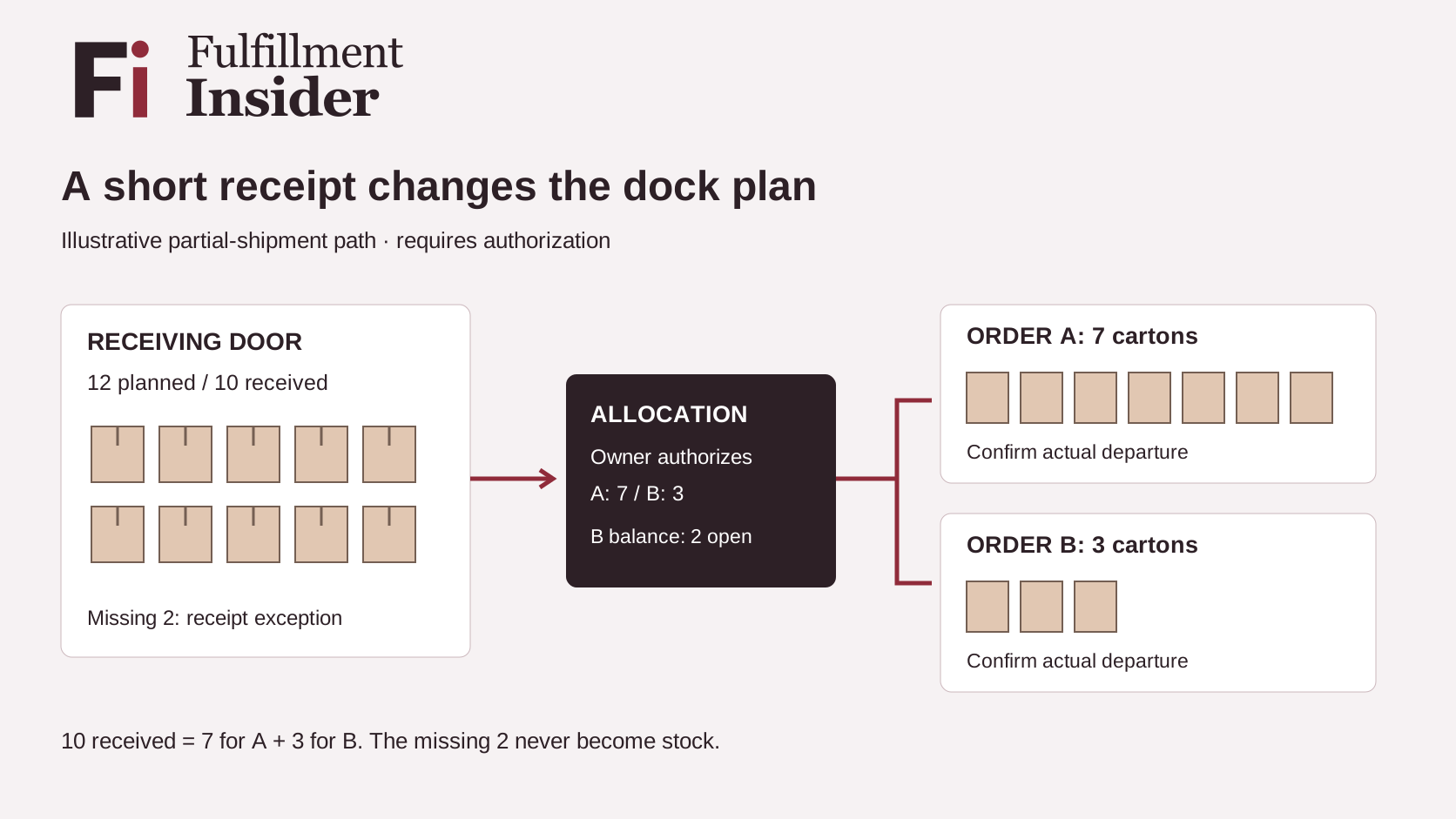
We constructed a fictional 12-carton plan: seven cartons allocated to Order A and five to Order B. Only ten cartons arrive. The cartons are interchangeable for this example, with no quality or lot restrictions. We traced three possible dispositions; none is a universal instruction to use that route.
| Illustrative decision | Shipped | Physically held | Still missing inbound |
|---|---|---|---|
| Partial B shipment is permitted | A: 7; B: 3 | 0 | 2 |
| B must remain a complete five-carton order | A: 7 | B: 3 | 2 |
| Neither order is released pending review | 0 | 10 | 2 |
Every row accounts for the ten received cartons. The two missing cartons never become available stock. In the partial-shipment case, Order B still needs a recorded decision about its unfulfilled balance. In the complete-order case, the three cartons held for B are real stock, but they are not a completed shipment.
This is an arithmetic and workflow exercise, not a WMS test. Actual customer terms may rule out one or more of these paths. The purpose is to make the decision visible before a loader treats the original plan as a departure record.
Name the person who can change the plan
A receiving employee can report ten cartons without having authority to choose which customer receives them. Define the allocation owner before the truck arrives. That owner should see the original plan, actual receipt, shortage and any order-specific restrictions.
Record the decision with the affected order references and the updated quantities. If the decision changes after staging, make the physical staging and outbound documentation agree before loading. A message that says “send what you have” is incomplete when multiple orders share the same inbound stock.
Close the movement, not just the exception ticket
At departure, reconcile the loaded handling units to the authorized outbound quantities. If cartons remain in the building, give them a known location and disposition so the next shift can find them. Keep the unresolved inbound balance attached to the supplier or receipt record instead of hiding it inside an outbound completion flag.
When evaluating a cross-dock provider, ask for a redacted short-receipt walkthrough. Look for separate receipt, allocation and departure evidence. The useful demonstration is not simply how quickly a pallet crosses the floor; it is how the system stays truthful when the planned quantity does not arrive.
Further reading
Sources
- GS1 Logistic Label Guideline, release 1.3 — accessed 2026-11-01.