
Unsold bundles do not become loose stock by themselves After a promotion, a brand may want to sell the components of remaining gift kits separately. Physically opening the boxes is only one part of the work. The inventory system also needs to stop promising those intact kits and start representing the recovered items correctly.
First identify the inventory model. Shopify's documented bundle availability calculation uses component availability and required quantities to determine complete bundles. That is not the same as a warehouse that has separately stocked, preassembled parent SKUs. Shopify bundle inventory considerations. Ask how your integration represents the physical kit before approving an adjustment.
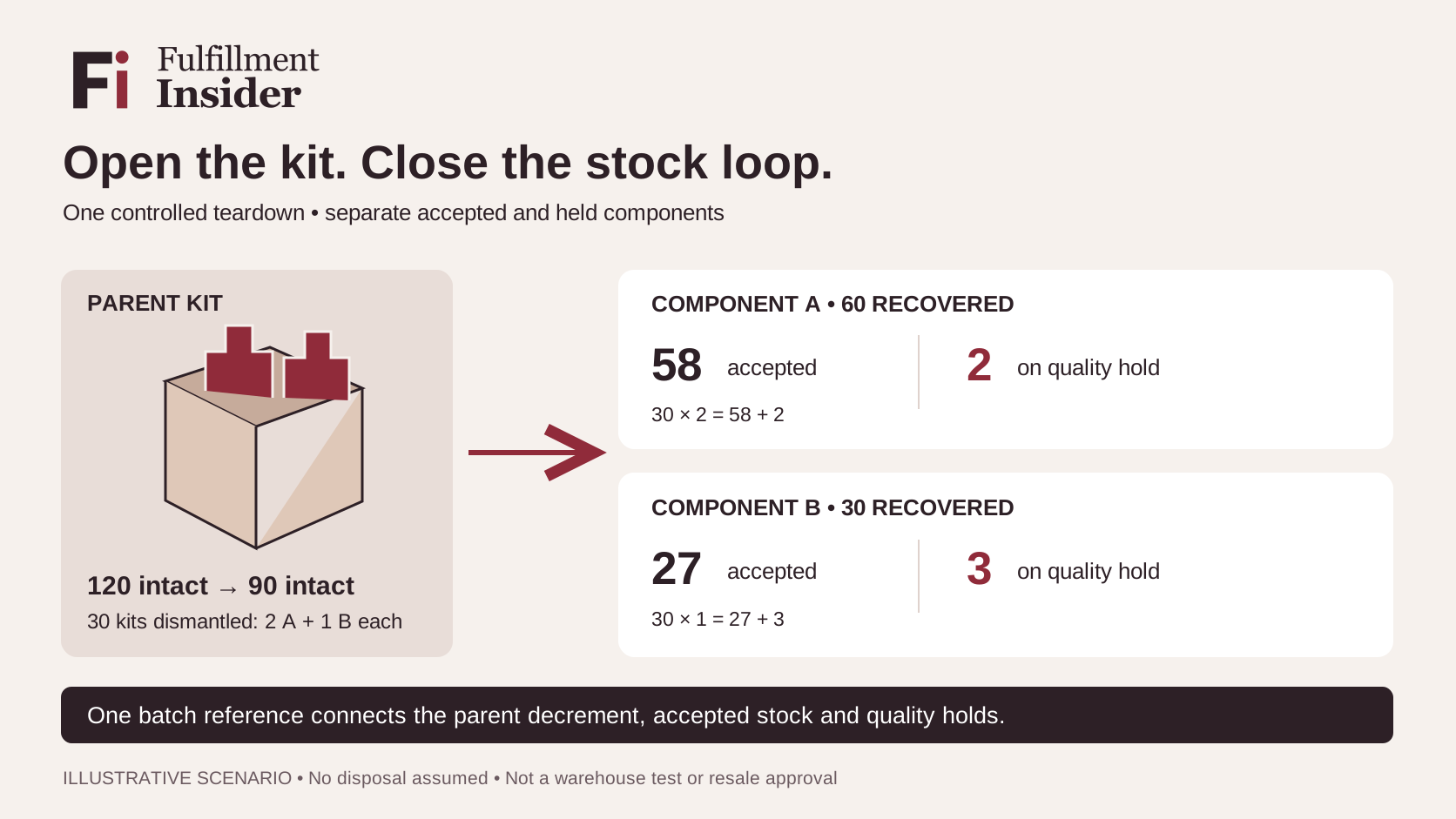
Follow one teardown batch We constructed a hypothetical preassembled kit containing two units of component A and one of B. The warehouse starts with 120 intact kits and is authorized to dismantle 30. Assume parent kits have their own stock balance and the components inside them are not simultaneously available as loose units.
Those 30 kits contain 60 A units and 30 B units. Inspection accepts 58 A units and 27 B units for resale; two A and three B remain on quality hold. No disposal or loss is assumed.
| Inventory record | Change after completed teardown |
|---|---|
| Intact kit stock | −30, leaving 90 |
| Loose A accepted for sale | +58 |
| Loose A on hold | +2 |
| Loose B accepted for sale | +27 |
| Loose B on hold | +3 |
The component conservation checks are 30 × 2 = 58 + 2 for A, and 30 × 1 = 27 + 3 for B. Keeping the two checks separate matters: a total of 90 recovered pieces alone could hide the wrong component mix.
Reserve the work before opening the first carton Move the chosen parent quantity into a controlled work state so normal picking cannot consume it during teardown. Record the parent SKU, recipe version, batch reference and expected outputs. Do not release components merely because a work order was created.
At completion, a reviewer should compare physical output counts with the recipe and record accepted, held and any separately authorized disposition quantities. The parent decrement and component postings need a common reference so a later investigation can reconstruct the conversion.
Shopify distinguishes available stock from unavailable stock such as quality-control holds. That distinction supports keeping inspected-but-unaccepted output away from customer allocation; the actual WMS integration must be checked separately. Shopify inventory states.
Check what can be promised afterward Suppose the accepted components could be used for a new virtual offer with the same recipe, with no other loose stock available. The A balance supports 29 complete sets; B supports 27. The limiting quantity is therefore 27. This is an additional calculation under the stated model, not permission to count those sets on top of the same components in every sales channel.
Ask the provider to show which system owns availability, how channels receive the result, and what prevents a retry from posting the teardown twice. Request the transaction export and an exception path for a job stopped halfway through. A completed demonstration should reconcile both the physical work area and the inventory records.
Put the acceptance rules in the project brief Specify whether packaging damage, broken seals, missing inserts or uncertain lot identity require a hold. Set those rules with the responsible brand team before the project begins. A low teardown labor quote is incomplete if someone later has to decide what the recovered stock actually is.
This exercise models one invented batch, not an observed warehouse process. It does not establish resale eligibility for food, cosmetics or regulated goods. Use product-specific acceptance requirements and validate the integration before releasing recovered inventory.
Further reading
Sources
- https://help.shopify.com/en/manual/products/bundles/eligibility-and-considerations — accessed 2026-10-29.
- https://help.shopify.com/en/manual/inventory-and-locations/fundamentals/inventory-states — accessed 2026-10-29.