
One arrival can contain two different records
A warehouse receives eight reusable totes. That tells you little about how many products came back. Some may be empty, one may contain a damaged item and another may have been returned to the wrong facility. If the receiving workflow equates a container scan with product receipt, a tidy asset count can conceal an incorrect stock balance.
GS1 describes the Global Returnable Asset Identifier as an identifier for reusable transport assets such as crates and pallets, including movements between businesses. That establishes the asset-identification purpose. It does not specify your merchandise ledger or prove that a particular WMS keeps the two records separate.
Reconcile two ledgers from the same movement
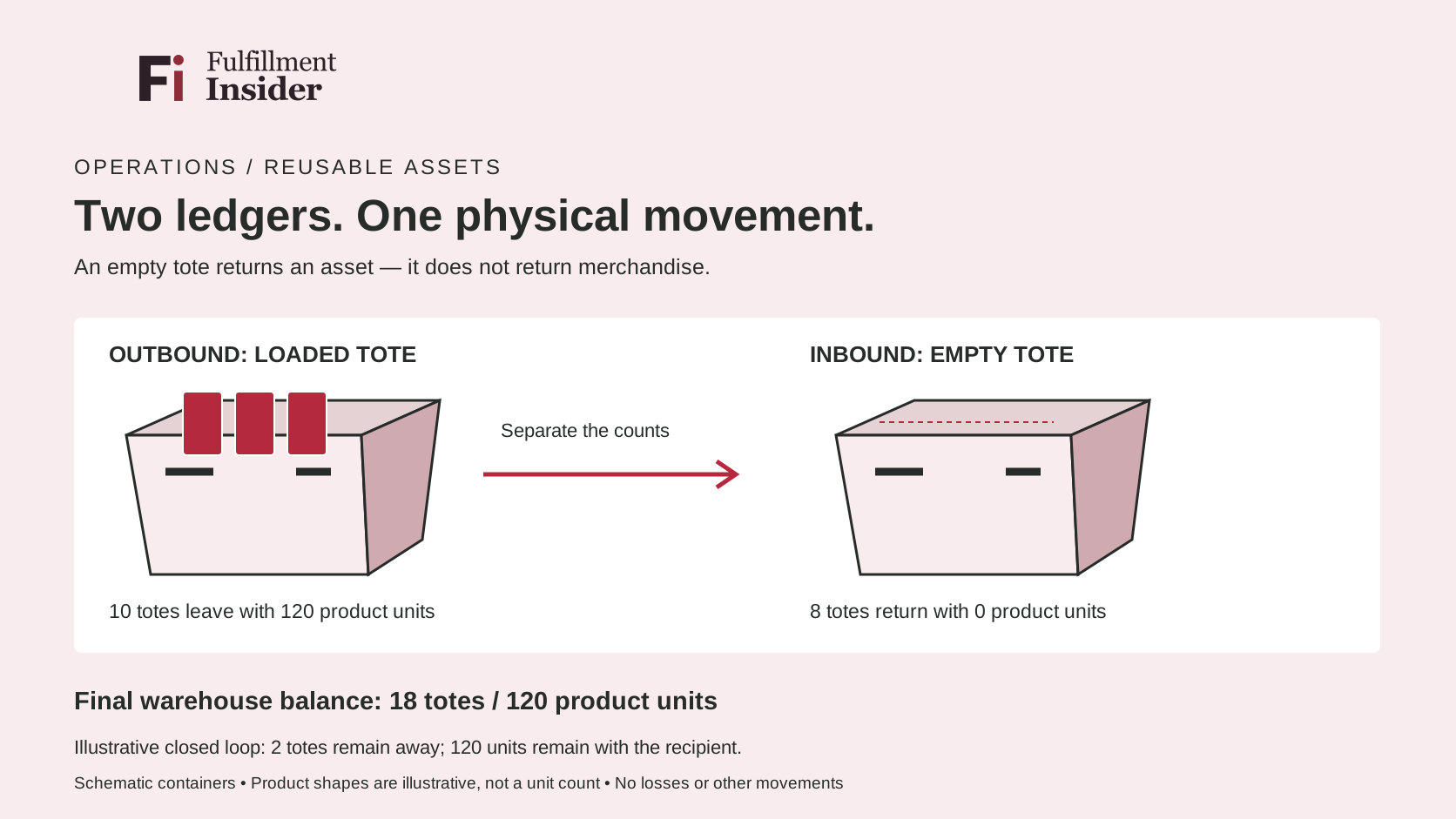
We constructed a hypothetical closed loop with 20 owned totes and 240 product units at a warehouse. Ten totes leave, each carrying 12 units. Eight empty totes return. All 120 shipped product units remain with the recipient; no product returns occur in this exercise. There are no losses, write-offs or other movements.
| Point in the exercise | Totes at warehouse | Totes away | Product units at warehouse | Product units at recipient |
|---|---|---|---|---|
| Opening | 20 | 0 | 240 | 0 |
| After dispatch | 10 | 10 | 120 | 120 |
| After eight empty totes return | 18 | 2 | 120 | 120 |
At the end, 18 plus two accounts for all 20 totes. The product ledger still has 120 plus 120, accounting for all 240 units. Adding 96 units because eight totes previously held 12 each would invent merchandise that never returned. Container capacity is not evidence of current contents.
This is an original arithmetic exercise, not a measured warehouse result. Its deliberately empty returns isolate the error. Real receiving must also deal with damaged containers, unknown owners and containers that contain product.
Give every event a quantity and a meaning
For dispatch, record the asset identity or controlled asset count, destination, movement reference and separately confirmed product quantities. On return, capture the asset condition and ownership before deciding whether it can re-enter the usable pool. Record merchandise only when actual contents are checked under the product-return process.
If a tote returns with two products, create the appropriate product receipt or hold event for those two units. Do not infer twelve from its old outbound load. If an asset belongs to another pool, resolve ownership rather than silently adding it to your available fleet.
Ask the provider to show how these events link. A common movement reference can connect the ledgers while keeping their quantities independent. The tool could be a WMS feature or another controlled system; the important question is whether the records reconcile and can be retrieved.
Test the exception that a dashboard hides
Request a demonstration with one empty tote, one partially filled tote and one unidentified tote. Ask which action changes asset availability, which changes merchandise stock and who can approve an adjustment. Record unresolved capabilities as unknown. The demonstration is proposed here; it has not been conducted.
Also agree how to investigate the two totes still away in the example. An open movement is not automatically a loss. It may need a recipient confirmation or a later collection. Rental or late-return charges, if applicable, need their own terms rather than being inferred from the inventory exercise.
A useful operational report shows both loops: containers awaiting return and products awaiting disposition. Combining them into one “returns received” number loses the distinction that keeps stock and reusable equipment trustworthy.