
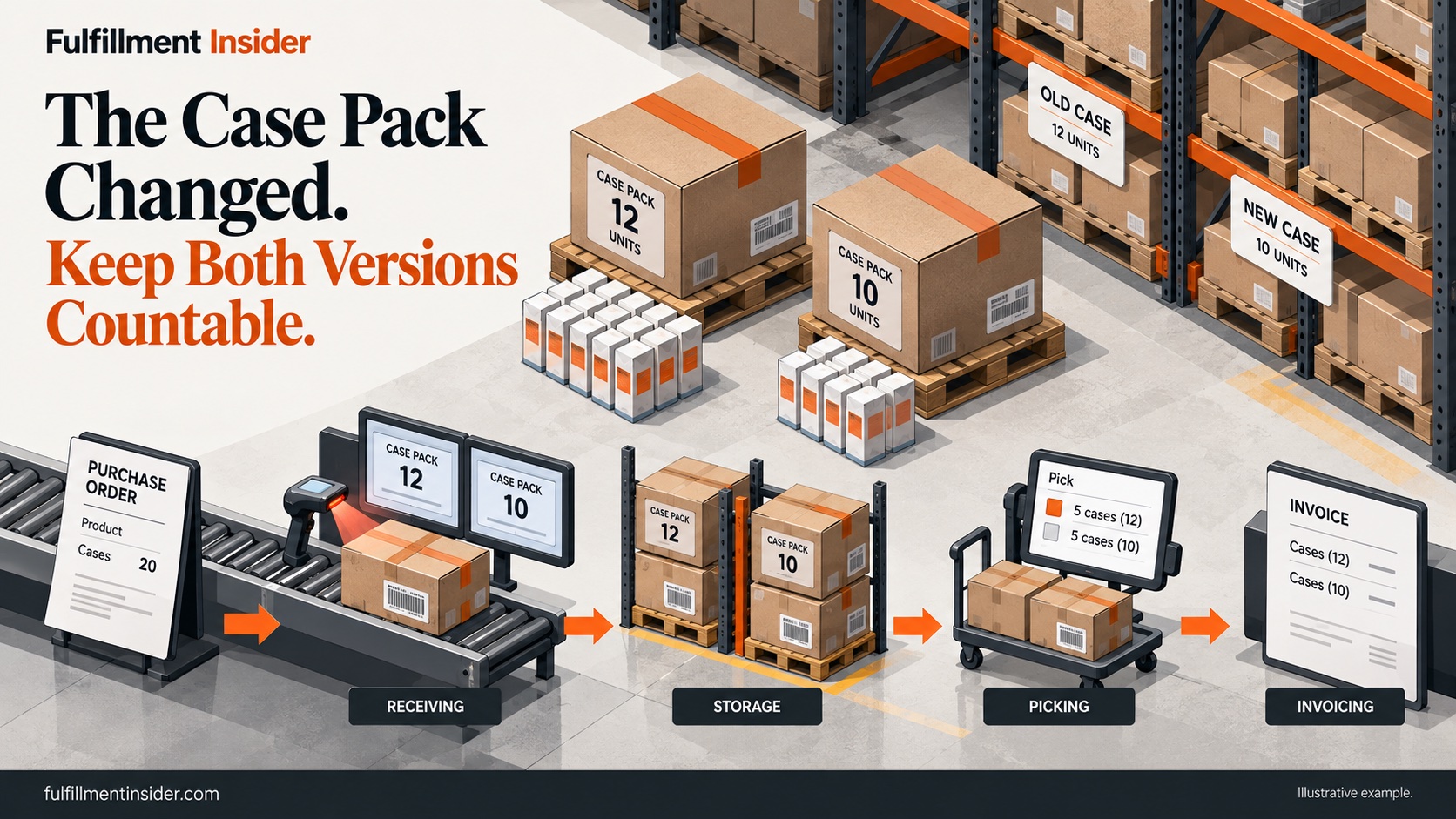
A supplier changes a case from twelve units to ten. The purchase order still says twenty cases. If the receiving screen keeps multiplying by twelve, the brand can appear to own forty units that never arrived.
The operational problem is not solved by changing one field to ten. Old twelve-unit cases may still be on the shelf. A single overwritten conversion can make yesterday’s stock and tomorrow’s receipts equally difficult to explain.
Identity belongs in the change request
GS1 US instructs users to create a new case and assign a new GTIN if the product or quantity of a case changes. That rule concerns the affected trade-item grouping; it is not a direction to invent a new identifier for every unchanged individual unit. GS1 pack/case quantity.
Ask who owns the case-level identifier and how it maps to the unchanged selling unit, where applicable. Keep retailer-specific requirements and internal warehouse codes visible alongside that mapping.
Reconcile in units before releasing stock
Our original calculation uses two invented receipts of twenty cases each. It holds the case count constant to expose a conversion error.
| Receipt version | Cases | Units per case | Physical units |
|---|---|---|---|
| Original case | 20 | 12 | 240 |
| Replacement case | 20 | 10 | 200 |
Applying the old factor to the new receipt creates an overstatement of 40 units: 240 minus 200. That is 20% of the actual 200 units, not a measured warehouse error rate. If both receipts remain available, the correct total is 440 units across two distinguishable case versions.
Preserve the version through the order
For the affected product, trace the purchase order unit, receipt unit, storage unit, pick instruction and invoice unit. An order for five cases is incomplete unless the parties agree which case configuration it means. Five old cases contain sixty units; five new cases contain fifty.
A proposed acceptance exercise should include both versions, one each-pick and one case-pick. Check what happens when a case is opened and its remaining pieces become loose stock. This is a desk-designed exercise, not a test we ran.
Close the old version deliberately
Request a dated change record identifying the last expected old-format receipt, the first new-format receipt and the disposition of mixed or unidentified cartons. Where a shipment cannot be identified reliably, resolve it before using an assumed conversion to make the receipt balance.
Do not remove the old mapping merely because purchasing has switched suppliers. Retain enough history to explain returns, invoice questions and adjustments tied to the earlier configuration. The change is complete when the team can reproduce both versions’ quantities—not when the product screen shows the newest number.
Related reading
Sources
- GS1 US: Create a Shipping Case — accessed 2026-10-17.