
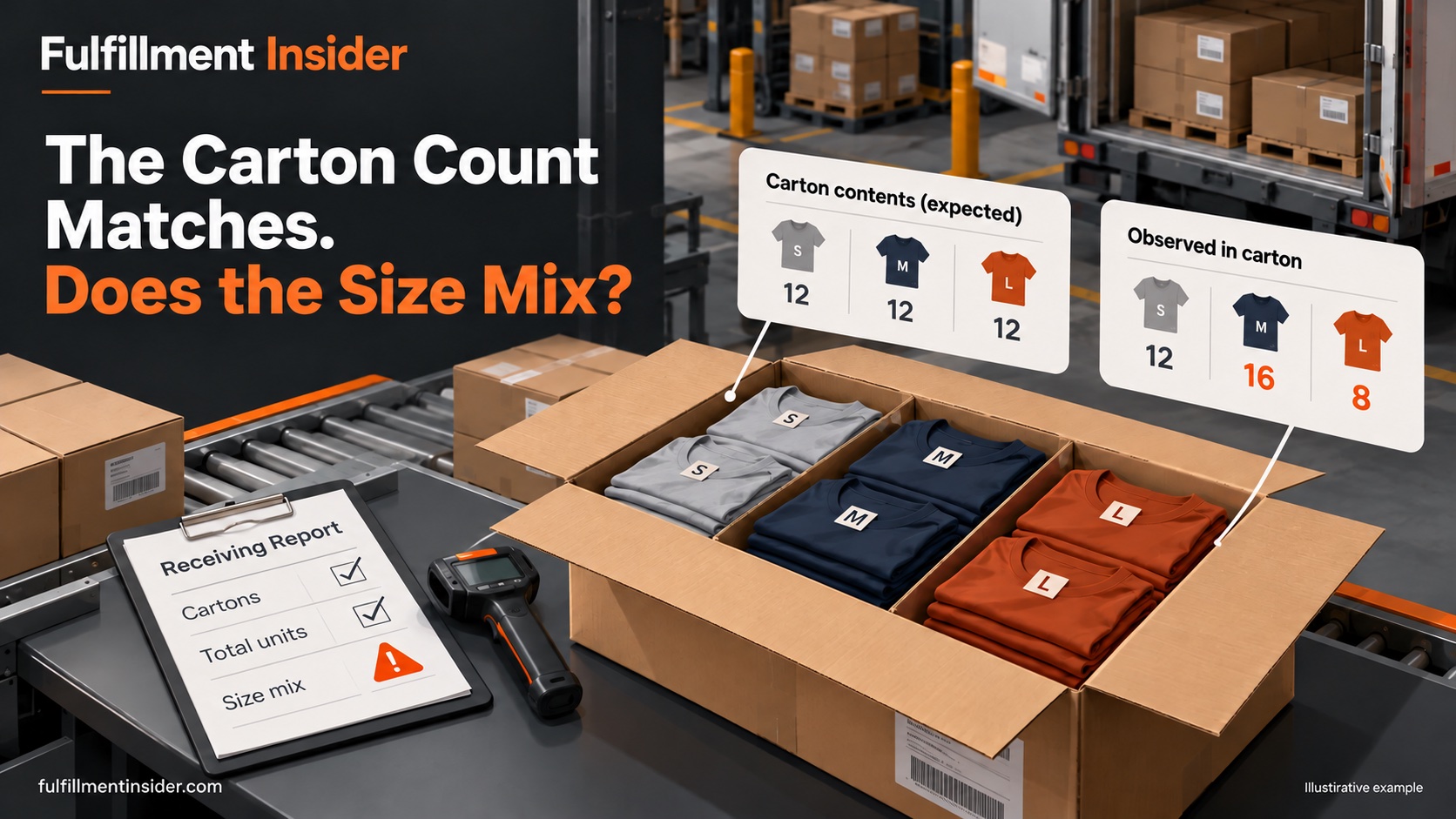
The receiving report shows every carton arrived and the total units match the expected quantity. That is reassuring until the first orders request a size that is missing. The problem was concealed by an equal excess in another variant.
For mixed cartons, the useful receiving unit is not only the carton. The warehouse needs a reliable way to connect each handling unit to its expected contents and then record what was actually found.
Identification is the link, not the contents
GS1’s logistic-label guideline distinguishes homogeneous units from heterogeneous units containing different trade items. For heterogeneous units, it strongly encourages electronic information linked to the SSCC, the identifier of the logistic unit. GS1 logistic-label guideline.
That distinction matters operationally: scanning the container identifier can retrieve a contents record, but the identifier alone does not verify every item inside. Confirm what the supplier file contains and which receiving checks your provider actually performs.
A matching total can conceal two errors
Illustrative apparel receipt: one mixed carton is expected to contain 12 small, 12 medium and 12 large units. The observed quantities in this fictional exercise are 12 small, 16 medium and 8 large.
| Variant | Expected | Observed | Difference |
|---|---|---|---|
| Small | 12 | 12 | 0 |
| Medium | 12 | 16 | +4 |
| Large | 12 | 8 | −4 |
| Total | 36 | 36 | 0 |
The total variance is zero. The large-size shortage is four units. A total-only acceptance would erase information needed for purchasing, availability and supplier follow-up. This is one constructed example, not an estimate of warehouse error frequency.
Agree on the check before the truck arrives
Specify whether the service includes container counting, SKU-level quantity checking or some other agreed inspection. State the exception process when the expected contents file is missing or does not match the physical receipt.
Do not silently turn an identifier scan into a claim of a full unit-level audit. If the contract uses sampling, make the sampling method and limits visible. Different checking scopes can be legitimate, but the inventory report should not imply more certainty than the work supports.
Preserve both sides of the discrepancy
Keep the supplier’s expected assortment and the warehouse’s observed count as separate records. Attach the carton reference, variant identifiers and relevant evidence. Correcting the available quantity should not overwrite the original expectation needed to investigate the shortage.
Assign the extra medium units an explicit decision too. Their presence does not automatically settle the missing large units, and the brand may need to determine whether the excess belongs to this shipment or requires further investigation.
Test the variant path during onboarding
Ask for a controlled example with a correct total and an incorrect assortment. Check whether the receiving result exposes each difference and whether the store receives the intended variant quantities. This is a proposed test, not one performed for this article.
The workflow succeeds when the buyer can see what arrived, what was expected and what remains unresolved. Matching the total is a useful check; matching the merchandise the customer can order is the next one.
Related reading
Sources
- GS1 distinguishes heterogeneous logistic units and linked electronic contents information — accessed 2026-10-09.