
Start with the contents, not the label printer A pallet can look orderly while its electronic contents are wrong. Imagine a single product arriving in two manufacturing lots. If a receiving operator records only the total against the pallet, the next outbound allocation may have no reliable way to distinguish those lots.
The buyer question is therefore more precise than “Can you print SSCC labels?” Ask whether the warehouse can retrieve the lot-level contents behind the pallet identifier and preserve them through picking and changes to the load.
Know what the label is allowed to say GS1 identifies the SSCC as the compulsory identifier on its logistic label. Its Logistic Label Guideline, release 1.3, section 4.7, says only one batch number can appear on a logistic label; where different batch numbers exist at the highest packaging level, those batch numbers cannot be shown there. This is a specific labeling rule, not permission to discard batch information in the records. GS1 guideline, GS1 SSCC explanation.
Agree the applicable label and data exchange requirements with the trading partner. Do not improvise a combined lot code that silently replaces two real lots.
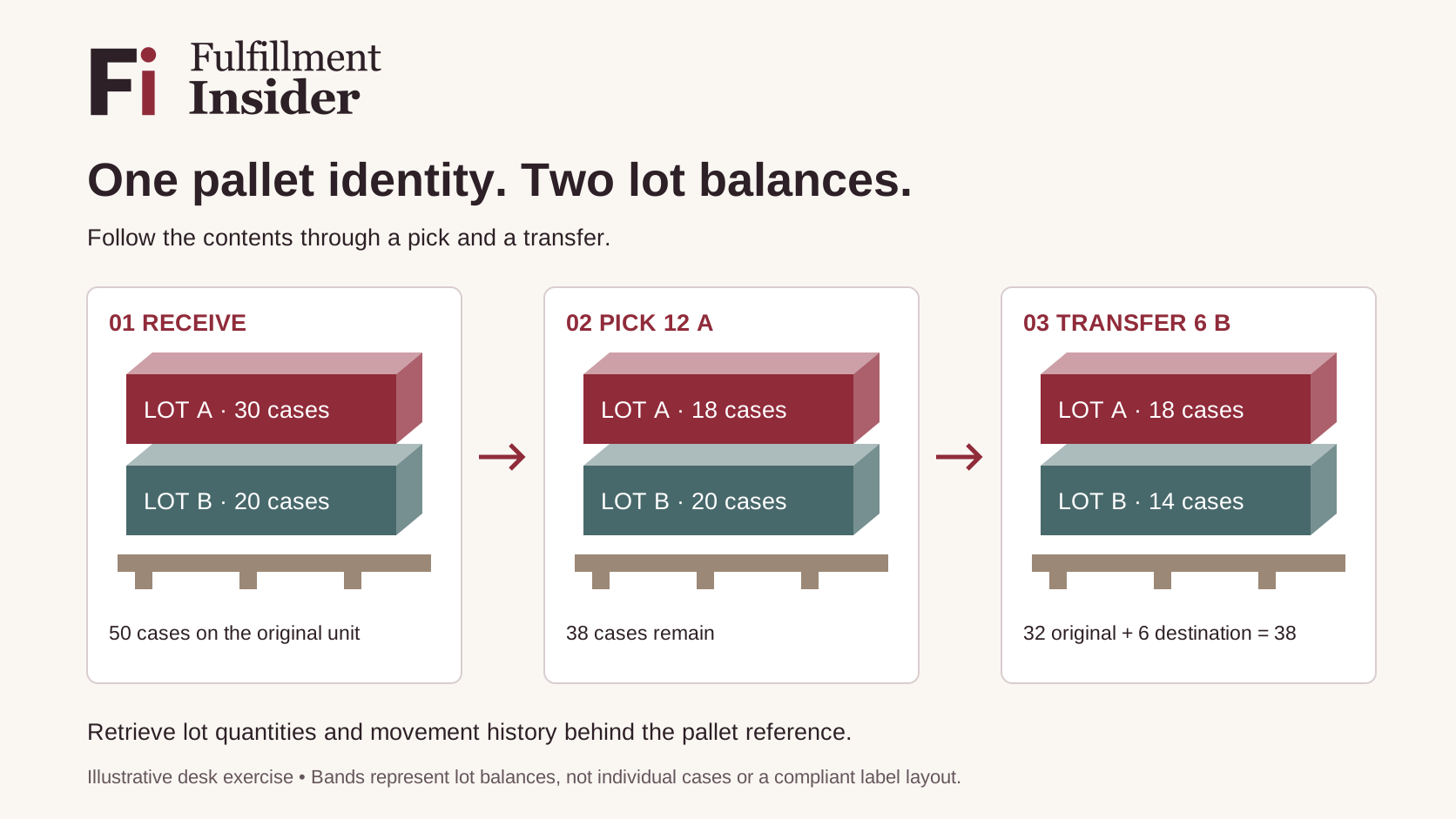
Run a small quantity reconciliation Our original desk exercise uses one hypothetical pallet, one SKU and two lots. It tests record consistency rather than the performance of any warehouse system.
| Event | Lot A cases | Lot B cases | Total cases |
|---|---|---|---|
| Received and associated with the pallet | 30 | 20 | 50 |
| Picked for a hypothetical order | 12 | 0 | 12 |
| Remaining after that pick | 18 | 20 | 38 |
The remaining total is easy to check: 50 minus 12 equals 38. But a record showing 38 without the split cannot answer how many cases of Lot A remain. A quantity-balanced pallet is not necessarily a lot-balanced record.
Now change the exercise: six cases from Lot B move to another handling unit. The original unit should show 18 A and 14 B, totaling 32; the destination should show six B. Across both units, 38 cases still remain. Ask the provider to demonstrate the association changes and its approved identification procedure. This exercise does not prescribe SSCC reuse or reassignment rules for a real repalletization.
Follow the exception to its owner A damaged or unreadable case label should not become a guessed lot value. Ask what status holds the affected stock, who may resolve the discrepancy and what evidence supports the correction. Request an example using synthetic data that shows both the original entry and the authorized change.
For an outbound load, reconcile the physical quantity, the lot-level inventory movement and the information sent to the recipient. A label photo can show what was printed; it cannot alone establish what the system allocated or what was actually loaded.