
Extra stock creates a decision, not an automatic benefit
A receiving team counts more units than the inbound record expects. Increasing the available quantity immediately may seem efficient. It also skips several questions: are these the right goods, do they belong to the brand, and who can approve keeping them?
Treat an overage as a reconciliation case with a disposition owner. The warehouse can document what arrived without deciding the commercial terms of a supplier discrepancy. Agree on that separation in the receiving procedure and on who pays for investigation or additional handling under your contract.
Reconcile the physical facts first
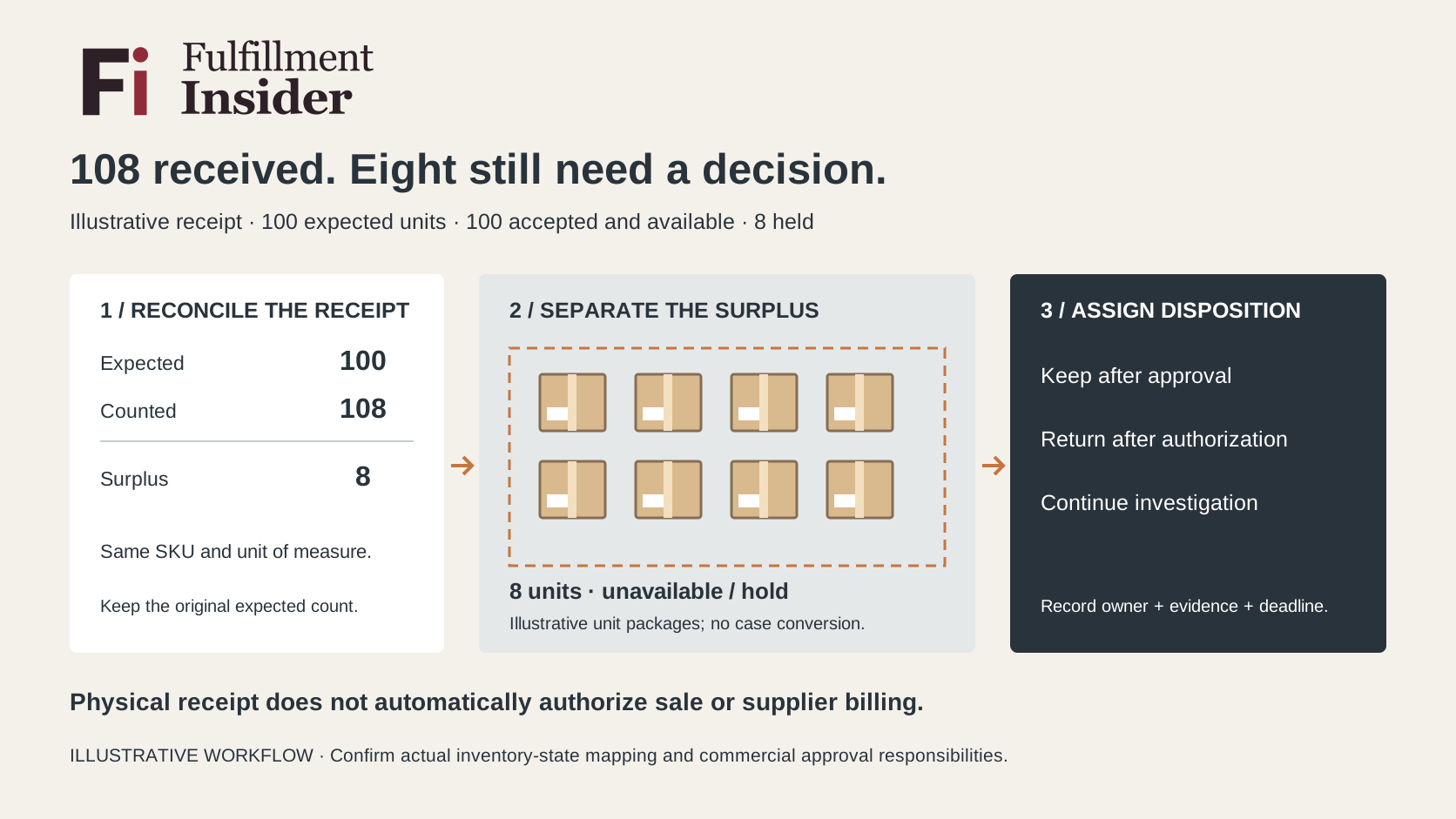
In this illustrative example, a purchase order expects 100 units of one SKU. A verified receipt contains 108 correctly identified units. The surplus is eight units. Before assigning a reason, check whether the count used the same unit of measure: eight pieces and eight cases are not interchangeable.
Record the purchase order, inbound shipment, SKU, unit of measure, actual count, package identifiers and any lot information required for the product. Preserve the original expected quantity. An edit that changes 100 to 108 without a reason removes the very discrepancy the buyer needs to investigate.
A recount should answer a specific uncertainty, such as a mixed carton or duplicated scan. It should not become an unexplained adjustment designed to make two screens agree.
A stock state does not settle the supplier question
Shopify distinguishes on-hand, available, committed and unavailable inventory. On-hand includes available, committed and unavailable units; incoming inventory is separate. These documented distinctions help explain why physical presence need not mean availability for a new order. They do not determine ownership or approve supplier billing.
For our example, assume the first 100 units are accepted, uncommitted and available. Keep the additional eight in an identified unavailable or equivalent hold state while the responsible brand contact decides their disposition. Verify the actual WMS-to-store mapping; a hold name in one system is not proof that another system excludes the units from sale.
Work through three possible outcomes
| Illustrative decision | Physical and system consequence | Evidence to retain |
|---|---|---|
| Keep the eight extra units | Release only after the specified approval and checks; available becomes 108 under our assumptions | Named approval, reason and corresponding adjustment |
| Return the surplus | Keep eight segregated until departure; on-hand becomes 100 after the eight leave | Return authorization and shipment record |
| Continue investigation | Physical total remains 108, with eight excluded from availability | Owner, unresolved question and review deadline |
These are alternative outcomes, not three sequential transactions. A return authorization alone does not reduce the number physically present. A commercial agreement to keep stock does not waive product-quality checks.
Give the hold a real endpoint
A useful receiving exception report names the decision owner and due date. It also identifies what happens if no response arrives: escalation, continued segregation and any agreed storage treatment. Do not make disposal the silent default.
Before closing the case, compare the receipt, inventory states, physical location and supplier correspondence. If extra units were released, check that the original hold was removed once, not offset by a second receipt that creates duplicate stock. If they left, retain the departure evidence.
Our analysis follows one hypothetical receipt and three dispositions. It does not establish a legal ownership rule or a specific software integration's behavior. Buyers should use it to define the receiving handoff: evidence of arrival, authority to decide, controlled stock status and a documented endpoint.
Related reading
Sources
- Primary source 1 — accessed 2026-10-27.