
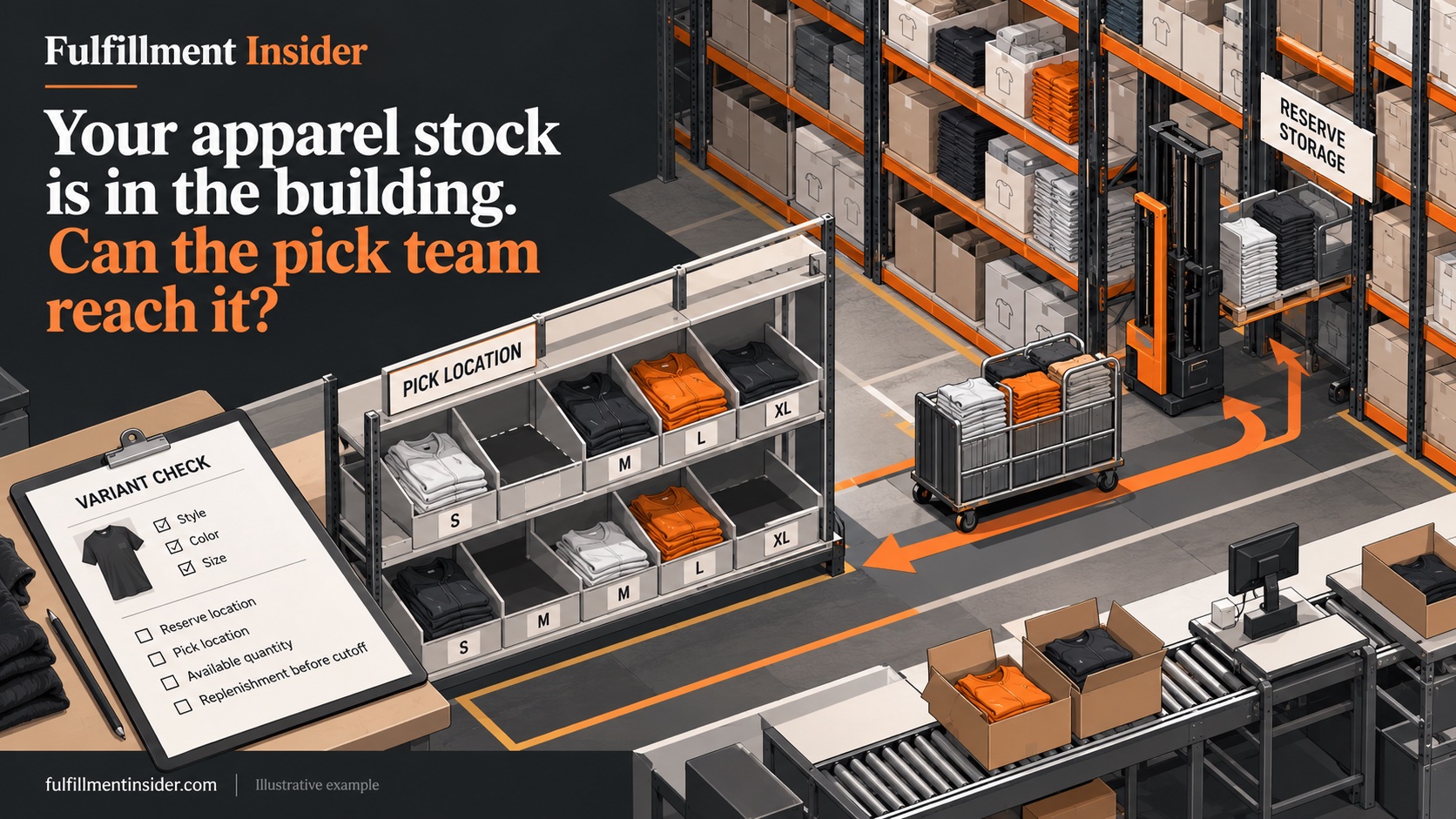
An apparel launch can have plenty of stock and still run short at the packing deadline. The units exist, but the right sizes are sitting in reserve storage while the pick locations empty out.
That is a different problem from buying too little inventory. It is a replenishment problem inside the fulfillment operation. Before a promotion, ask your 3PL to show how the expected size mix moves from storage to the places where orders are picked.
Follow one variant through the building
A product family total is too broad for this check. Use a specific style, color and size, then identify its reserve location, pick location, available quantity and any restrictions on moving it.
Inventory labels also need interpretation. Shopify's inventory documentation, for example, separates on-hand units into available, committed and unavailable states. Those commerce states do not establish that a picker can reach a unit before a deadline. That physical-readiness question needs warehouse evidence.
Ask the 3PL which report connects the sellable quantity to the physical locations and pending moves. The report's name matters less than whether an operations lead can use it to spot the next shortage.
A small example exposes the constraint
We calculated a hypothetical two-variant launch below. Each order contains one unit, the demand arrives before the dispatch cutoff, and all reserve units are otherwise eligible for sale. These are scenario inputs, not observed warehouse results.
| Variant | Orders due | Units at pick location | Units in reserve | Units moved to picking before cutoff |
|---|---|---|---|---|
| Medium | 180 | 40 | 300 | 100 |
| Large | 60 | 80 | 100 | 0 |
The building contains 520 units against 240 orders. Nevertheless, only 140 medium units can be picked before cutoff: the original 40 plus the 100 moved in time. The large orders use 60 units, leaving 20 large units in the pick location.
At most 200 orders can therefore be completed under these assumptions. Forty medium orders remain exposed, even though total inventory looks comfortable. Extra large units cannot satisfy medium orders without changing what the customer bought.
This is a deliberately simplified bottleneck calculation. It does not include packing speed, labor breaks, carrier collection or other constraints. Passing this check would not establish that the full operation can dispatch 200 orders.
Give replenishment a trigger and an owner
A useful launch plan states when the next move starts, who performs it and what confirms completion. “We replenish as needed” leaves too much unanswered if the team is already handling a surge.
Discuss whether the trigger comes from a remaining quantity, expected demand during the move time or a scheduled review. Then check the physical path. Case opening, scanning, travel and access to reserve storage can all be questions for the walkthrough; do not assume they are included in a quoted picking rate.
Ask for a fallback if the planned move cannot happen. That might mean an approved alternative pick location or a revised order-release sequence. The choice must fit the facility's actual controls rather than a generic instruction to work faster.
Review the release in size-level terms
Before opening the promotion, compare expected orders with pick-ready stock and replenishment that can finish in time. Afterward, examine the orders delayed specifically by replenishment, keeping them separate from orders waiting on inbound stock or a quality decision.
This gives the brand and warehouse a more useful improvement target than a single stock-availability percentage. A strong apparel fulfillment plan makes the right variants accessible when the orders need them.
Related reading
Sources
Research checked October 2, 2026. Recheck source-specific requirements before publication.