
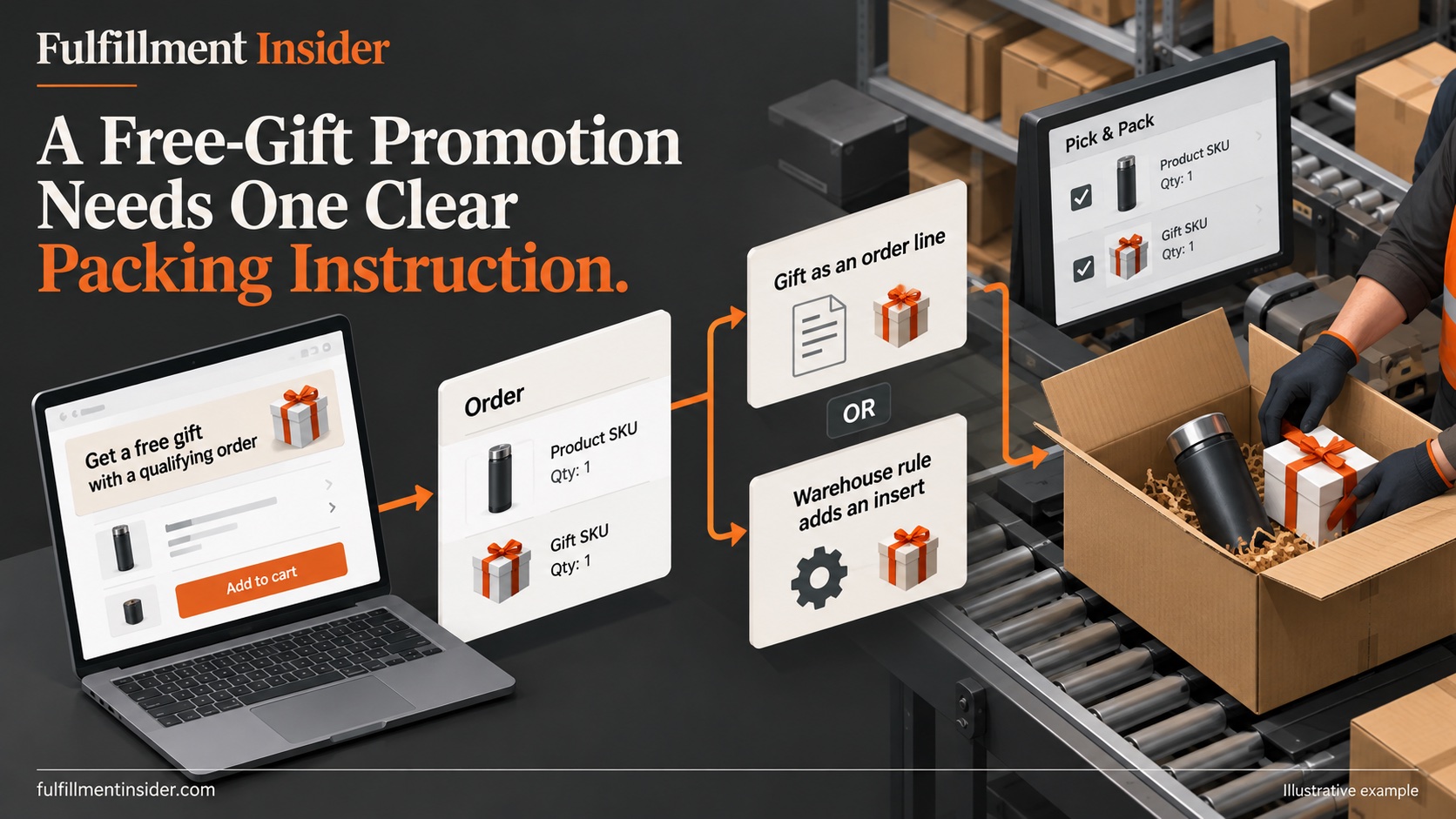
A promotion has two separate jobs
Marketing decides which shopper qualifies. Fulfillment needs an unambiguous instruction about what to pack. A discount configuration does not necessarily create that instruction.
For Shopify's native Buy X get Y discounts, customers must add the applicable items to the cart; the free item is not automatically added. Apps and custom workflows can change the implementation, so establish which mechanism your store actually uses. Shopify Buy X get Y documentation.
Before launch, ask the ecommerce owner and 3PL integration owner to follow one order from checkout to the warehouse's packing view. A screenshot of the offer banner proves very little about that handoff.
Choose a single instruction owner
There are two possible designs to discuss. The commerce system can send a gift SKU as an order line, or an agreed warehouse rule can add an insert based on defined eligibility. Neither should operate invisibly alongside the other.
If the order already includes the gift and the warehouse also adds one through a promotion rule, the customer may receive two. If each team assumes the other creates the instruction, the customer may receive none. Write down which system creates the physical packing requirement and how the other system recognizes it.
Run a four-case test
Use four synthetic test orders in an agreed test environment. First, a qualifying basket with the gift explicitly included should produce the expected gift quantity. Second, a qualifying basket without a gift line should expose the behavior of the configured promotion; do not assume the warehouse will infer a missing line.
Third, a nonqualifying basket should not trigger an unauthorized free insert. Fourth, an order carrying a gift line should be evaluated with any proposed warehouse insert rule to detect duplication. Do not send these tests into live fulfillment without an agreed test procedure.
For every case, record the cart contents, order lines sent, warehouse lines received and expected packing result. The comparison is more useful than a simple pass mark because it shows where a mismatch first appears.
Decide what happens when the gift runs out
A gift SKU still needs inventory ownership. Agree whether an unavailable gift holds the order, removes the promotion or requires a customer-facing alternative. Do not let packers substitute another product based only on visual similarity or spare stock.
Also agree what happens after an order edit or cancellation. A changed eligibility decision must not leave an old packing instruction active. Identify the point after which warehouse work cannot be stopped reliably and define the escalation path.
Give operations a launch and stop signal
Document the promotion window, the relevant time zone, the gift identifier, quantity rule and responsible contacts. Shopify documents discount timing against the store administration time zone; verify the operational schedule against the actual configured system.
End the promotion deliberately. Remove or disable any warehouse rule through its owner and check that later orders contain no stale insert instruction. A successful promotion ends cleanly as well as starting correctly.
Related reading
Sources
- Primary source or planning context — accessed 2026-10-15. Native Shopify Buy X get Y discounts require applicable items in the cart; the free item is not automatically added. Apps or custom workflows may behave differently.