
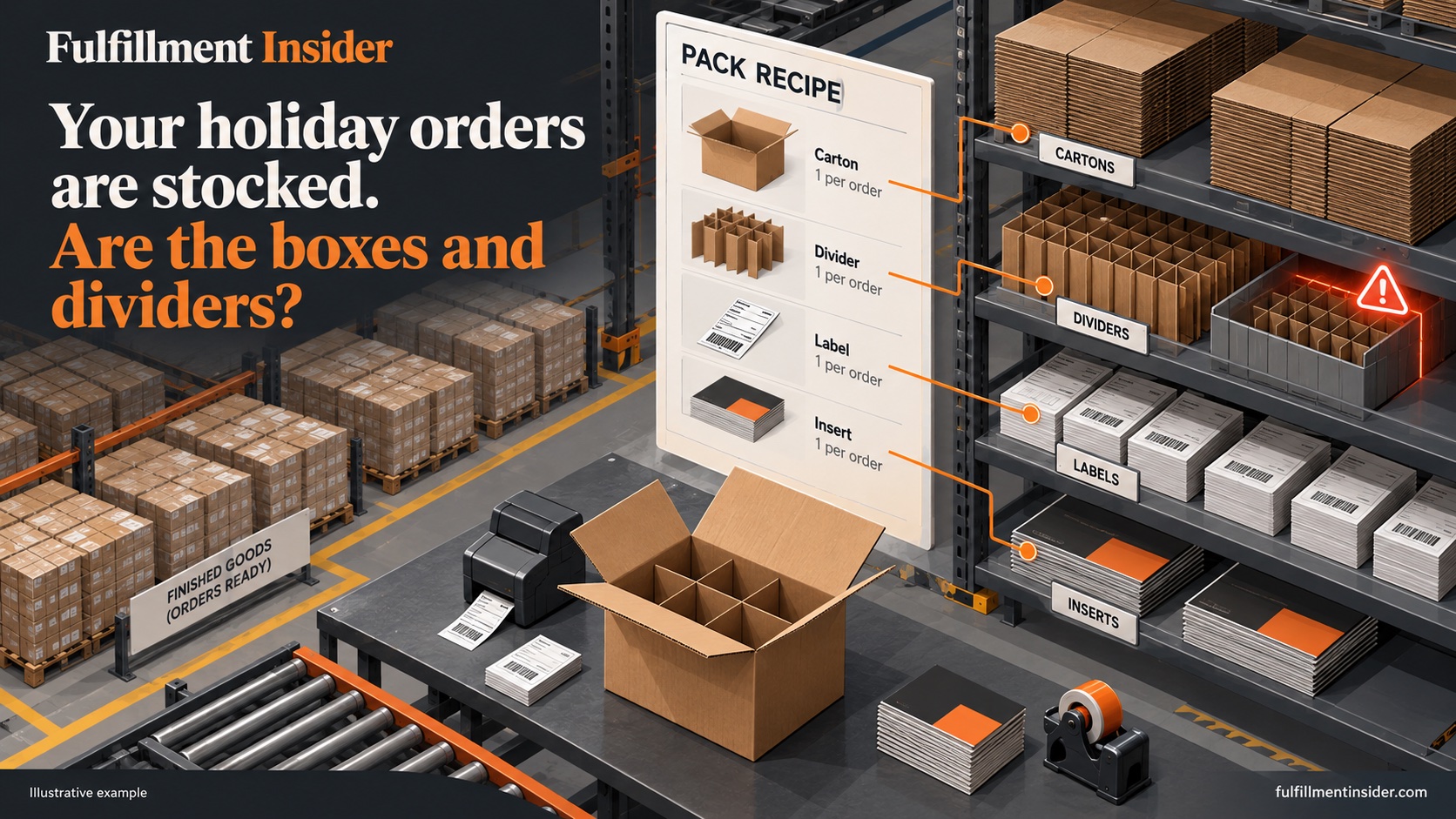
The product inventory report can be entirely green while the packing station is one shift away from stopping. Finished goods and shipping materials are different inventories, and a promotion needs both.
The overlooked item is often ordinary: a divider, an insert or the right carton. Someone sees boxes in a storage bay and assumes the promotion is covered. The pick team discovers later that those boxes belong to another account or that the available format does not fit the approved pack.
Translate the promotion into a material recipe
Give the warehouse an approved bill of materials for each order type. That is simply the list and quantity of supplies needed to pack it. Record the carton, protective components, labels and any branded insert. Identify which items the 3PL supplies and which the brand purchases.
A material count becomes useful only when it connects to consumption. Two thousand dividers could support two thousand orders or one thousand orders, depending on the pack recipe. Include rework consumption when you have a defensible measurement; do not hide it inside an arbitrary safety allowance.
Packaging substitutions also need a technical check. FedEx's liquid-shipping guidance describes protective components such as dividers and absorbent materials for relevant liquid shipments. That is one concrete reason a missing component cannot automatically be replaced with whatever is nearest. Follow the requirements for the actual product and carrier service.
A three-material runway check
We calculated a hypothetical promotion shipping 600 identical orders per operating day. Each needs one carton, one divider and one label. Assume no incoming supplies, no additional scrap and no other consumption. Physical stock includes 1,800 dividers, but 300 are reserved for another job.
| Material | Usable and unreserved units | Orders supported | Runway at 600 orders/day |
|---|---|---|---|
| Carton | 2,400 | 2,400 | 4 days |
| Divider | 1,500 | 1,500 | 2.5 days |
| Label | 5,000 | 5,000 | 8.3 days |
The dividers constrain the plan. Adding more finished goods does not change that result. Counting the reserved dividers would incorrectly stretch the apparent runway to three days.
Suppose replenishment takes five operating days and the brand chooses a two-day buffer. At the assumed demand, the simple planning target is 600 × 7 = 4,200 usable units of each material. With no open purchase orders, the gaps are 1,800 cartons and 2,700 dividers; labels have no gap against this target. The figures are original illustrative calculations, not recommended universal safety-stock levels.
A reorder placed today still arrives after the divider runway ends. The team therefore needs an immediate decision about an approved substitute, faster replenishment or the promotion's shipping plan. A purchase order alone does not resolve the interruption.
Make receiving part of the supply lead time
Ask whether the supplier's quoted lead time ends at shipment, warehouse arrival or usable stock. An uncounted pallet outside the packing area cannot support an order just because the supplier marked it delivered.
Keep open purchase orders separate from stock already available. Record their expected usable dates and confidence. If the promotion mix changes, recalculate consumption by order type instead of assuming yesterday's average still applies.
Agree on substitutions while the line is running normally
For each critical material, record an approved alternative or explicitly state that none has been approved. Specify who can authorize a change, which pack instructions must change and whether a sample needs review. Check the resulting parcel dimensions and weight before treating a larger box as a cost-neutral replacement.
The brand should also settle who owns leftover custom packaging and how it will be counted, stored or removed after the promotion. That prevents a temporary stock problem from becoming a recurring reconciliation problem.
At the daily operating check, review the shortest material runway alongside order backlog and product availability. The useful question is not whether the warehouse has packaging. It is whether the next planned orders have every required component before the next usable receipt.
Related reading
Sources
- FedEx guidance on protective materials for liquid shipments — accessed 2026-10-03.