
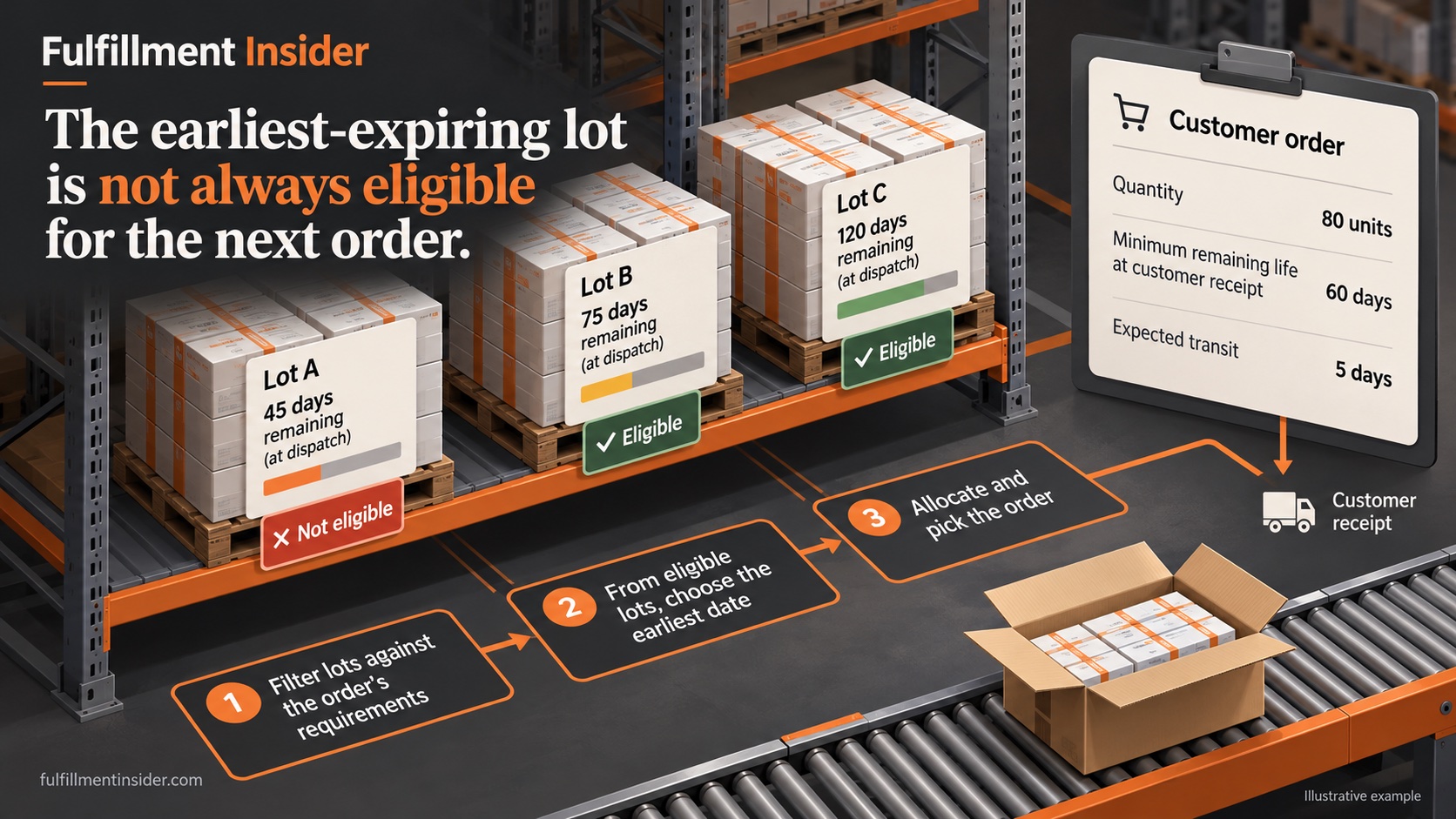
A pick rule can be followed perfectly and produce the wrong shipment. Consider first-expiring, first-out, often shortened to FEFO. It is useful for rotating dated inventory, but it does not answer whether a particular customer can accept the lot selected.
The operating question is not simply which lot expires first. It is which eligible lot should be used for this order, given the date requirement and the point at which the customer measures it.
Start by naming the date
Do not put every product date into a generic expiry field. GS1 distinguishes best-before, sell-by and expiration dates in its labeling guidance. Its framework helps identify what a date means; it does not establish your customer's contractual remaining-life requirement. GS1 logistic label guidance
For the example below, the brand and customer use a specified expiration date. The requirement is a hypothetical commercial condition, not a universal food or supplement rule: at least 60 days must remain at expected customer receipt.
Work from receipt, not just dispatch
Our desk exercise uses one SKU and three lots, each with 100 units. They have 45, 75 and 120 days remaining at dispatch. Expected transit takes five days. No lot is held, and each is otherwise eligible.
| Lot | Days remaining at dispatch | Days at expected receipt | Meets the example's 60-day requirement? |
|---|---|---|---|
| A | 45 | 40 | No |
| B | 75 | 70 | Yes |
| C | 120 | 115 | Yes |
There are 300 physical units but only 200 eligible units for this customer. For an order of 80 units, lot B is the earliest eligible choice. Selecting lot A merely because it expires first would fail the stated rule. For an order of 220 units, the operation has an eligibility shortage of 20 even though the building holds enough stock.
This is arithmetic applied to constructed inputs, not a shelf-life study or a warehouse test. It shows why an inventory total cannot stand in for an allocation decision.
Keep commercial eligibility separate from safety holds
A lot that fails one customer's remaining-life threshold is not automatically unusable for every customer. Conversely, meeting that threshold does not establish product safety, quality release or correct storage. Those require their own controls and evidence.
Shopify distinguishes unavailable inventory, including quality-control holds, from quantities available for sale. That is a useful reminder when interpreting inventory feeds; it is not proof that a connected 3PL system implements customer-specific dated-lot eligibility. Shopify inventory states
Ask the provider to show both controls in its proposed workflow: hold status first, then order eligibility, then date-based selection among the remaining lots.
Design the exception before the shortage
Agree who may approve a different lot, a partial shipment or a revised delivery date. Record any customer-approved exception with the order rather than overwriting the general rule. If transit changes from five days to twenty, the example's lot B arrives with 55 days left and no longer qualifies. Allocation therefore needs a point for checking whether the original assumptions still hold.
Before launch, present one normal order, one quantity shortage and one delayed-arrival case. Ask for the selected lot, rejected lots and reason for each decision. The practical evidence is an explainable allocation record. A FEFO checkbox tells you far less about whether the customer will accept the delivery.
Related reading
Sources
- Distinct product-date identifiers — accessed 2026-10-04.
- Available and unavailable stock definitions — accessed 2026-10-04.