
Start with the parcel you have
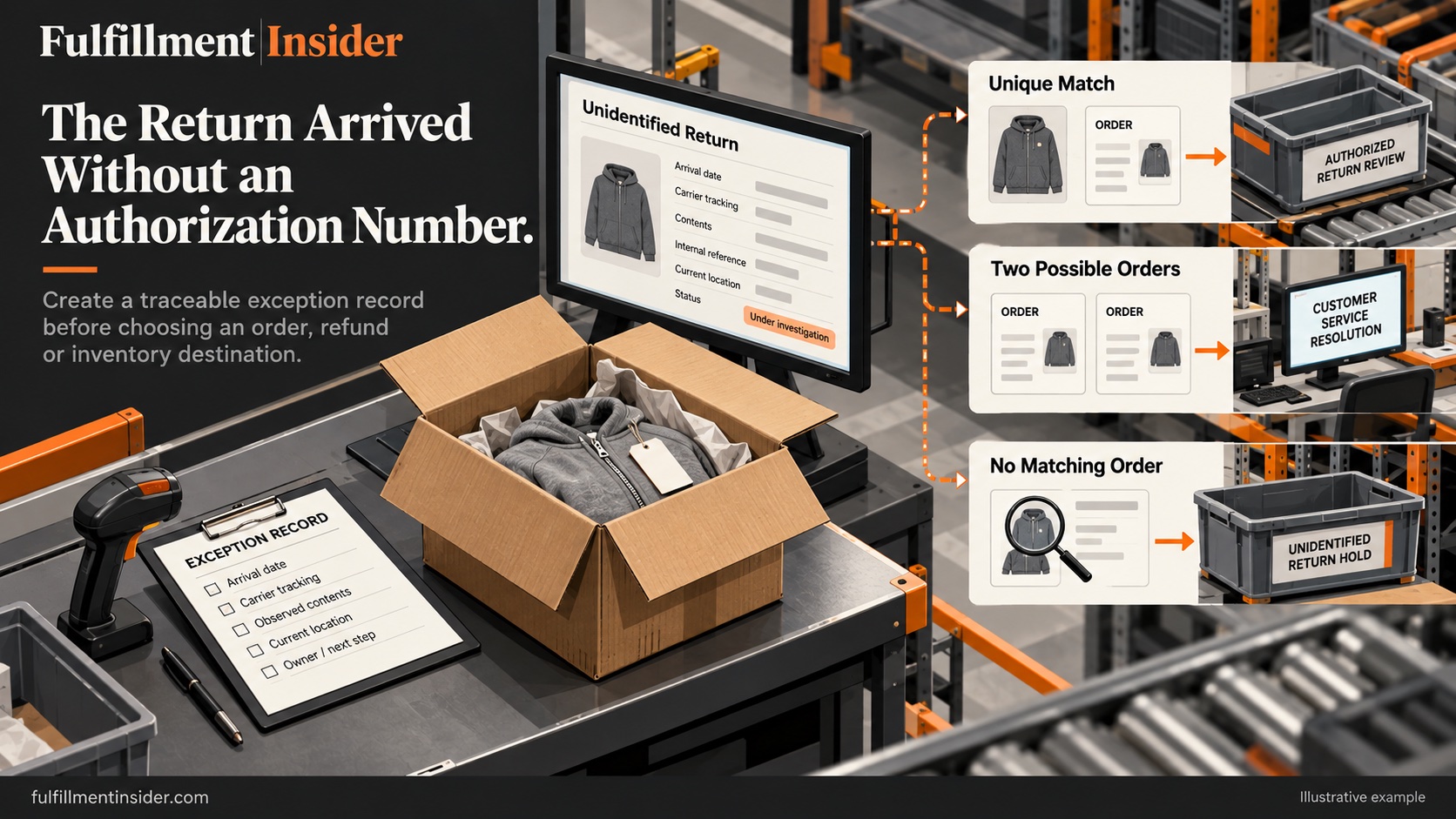
A return can reach the warehouse without the return authorization number your process expects. The item looks familiar, but that does not identify the order or prove that a refund is due. The first warehouse task is to preserve a reliable record of what arrived while customer service resolves the identity.
A return merchandise authorization, often shortened to RMA, is a reference used to connect a return to the business process. Its absence should create a controlled exception, not an invitation to choose the first matching order. Ask a 3PL how that exception appears in its system and how your team finds it later.
Test three identification cases
We constructed three desk scenarios to identify the decisions a buyer should ask a provider to demonstrate. No warehouse was tested, and these cases do not estimate how often matching succeeds.
| Evidence available | Proposed next step | Decision to avoid |
|---|---|---|
| One order and item can be uniquely matched | Send the match for the normal authorized-return review | Treating identification as automatic refund approval |
| Two plausible orders contain the same item | Ask customer service to resolve the ambiguity | Guessing from the most recent order |
| No matching order is found | Keep an unidentified-parcel case with an owner | Creating sellable stock to clear the receiving queue |
For each case, the physical parcel needs a stable internal reference. Record arrival date, carrier tracking when present, observed contents and where the parcel is held. Store customer information only in the approved system and restrict access appropriately. The purpose is to reconnect the parcel and the investigation without spreading personal data through informal messages.
A platform return record has its own conditions
Shopify's documented workflow creates a return from an order and specifies the items and quantities. Its guidance says a return can be created only for fulfilled items that have not been refunded; it also distinguishes receiving the goods from processing the return and issuing a refund. Those constraints matter if a customer was already refunded before the parcel arrived. Shopify return guidance.
Do not force an unmatched parcel into an unrelated order merely to satisfy a screen. Have the provider explain its supported exception path, including what happens when the commerce platform cannot accept the usual return transaction. Document the approved reconciliation route with your operations and finance teams.
Identity and condition need separate answers
Once the order is confirmed, the product still needs the normal condition review and disposition decision. A correct identity does not make an opened item resellable. Conversely, an item in good condition may still lack the evidence needed to resolve the customer case.
Ask for separate fields or otherwise clear distinctions between “order matched,” “condition assessed” and “disposition authorized.” The exact software design can vary. What matters is that one event cannot silently stand in for all three.
Keep the exception from becoming permanent storage
Agree on a review cadence, a responsible customer-service contact and the evidence needed to close a case. Escalate aging cases under the agreed policy; do not invent a disposal deadline at the receiving bench. Commercial and product-specific requirements can affect the final decision.
During 3PL evaluation, walk one synthetic ambiguous case through the proposed process. Ask who sees the alert, who can correct the match and how the physical parcel is located. A useful demonstration ends with a controlled decision trail. It does not need to pretend that every mystery parcel can be solved on arrival.
Related reading
Sources
- https://help.shopify.com/en/manual/fulfillment/managing-orders/returns/creating-returns — accessed 2026-10-20