
The order exists, but what happened to availability?
A wholesale customer asks for 60 units and receives an invoice. The account manager believes those units are held. Meanwhile, the online store continues selling them. The important question is not whether someone created an order record. It is whether an explicit reservation changed the stock available to other buyers.
Shopify documents this distinction for draft orders: reserving inventory puts those units in the Committed state; without a reservation, they remain Available. Inventory tracking must be enabled, and the reservation workflow includes an expiry date and time. Shopify draft-order reservations.
Follow 100 units through two possible paths
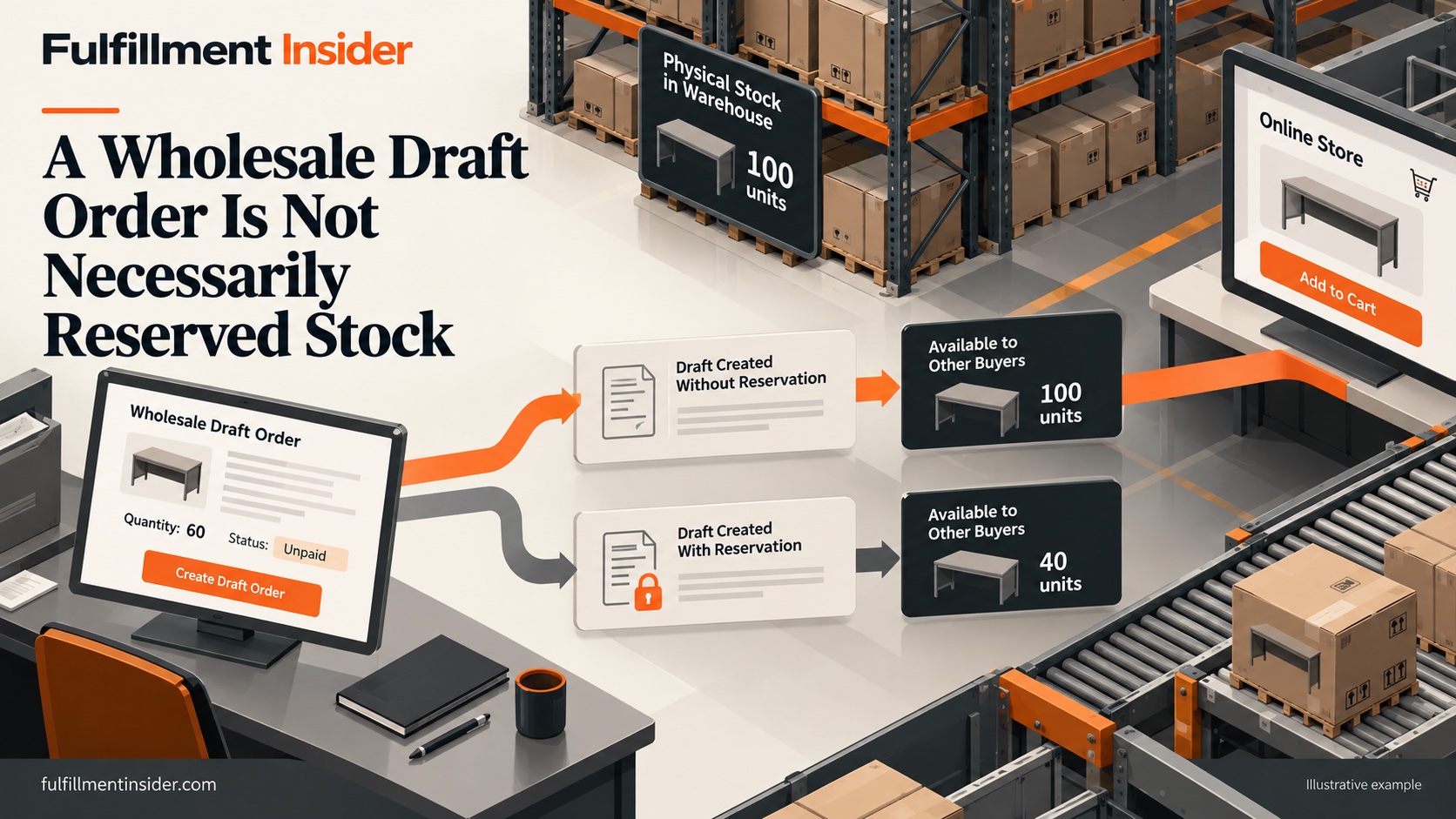
Our illustrative desk example begins with 100 available units, no other orders and a 60-unit draft. It isolates reservation behavior and assumes no receipts, damage or sales during the comparison.
| Event | Physical units | Available units in the example |
|---|---|---|
| Before the draft | 100 | 100 |
| Draft created without reservation | 100 | 100 |
| Sixty units explicitly reserved instead | 100 | 40 |
The two paths contain the same physical stock. They expose very different quantities to other buyers. A warehouse count alone therefore cannot prove the commercial reservation is working. Conversely, a lower available quantity does not prove that goods have left the building.
Identify the message that crosses the boundary
Ask the 3PL which system owns the reservation and what it receives from Shopify. Does the warehouse receive a draft, a reservation event, a paid order or some other message? Do not assume a Shopify state change automatically creates a matching warehouse hold.
Use a test plan with three events: create the draft without reserving, reserve it, and release or expire the reservation. At each event, capture the storefront state, warehouse state, timestamp and expected next action. If the provider cannot demonstrate an event safely, record it as unverified rather than filling in the result.
Include a competing retail order in the proposed test. The question is whether that order can consume the units that should be protected, and which system would prevent it. This is a proposed acceptance exercise; our desk research did not execute a connected-store test.
Give every reservation an owner
An indefinite hold can hide sellable stock; an unnoticed expiry can undermine a customer promise. Name the person who can extend a reservation and the person who tells the customer when it will lapse. Put the expiry time in the sales record, not just in a private message.
Before accepting a 3PL's “inventory sync” assurance, ask for this small state-by-state walkthrough. The most useful evidence is a consistent explanation of why stock is available, committed or released. Matching physical totals is only one part of that explanation.
Related reading
Sources
- https://help.shopify.com/en/manual/fulfillment/managing-orders/create-orders/create-draft — accessed 2026-10-16